
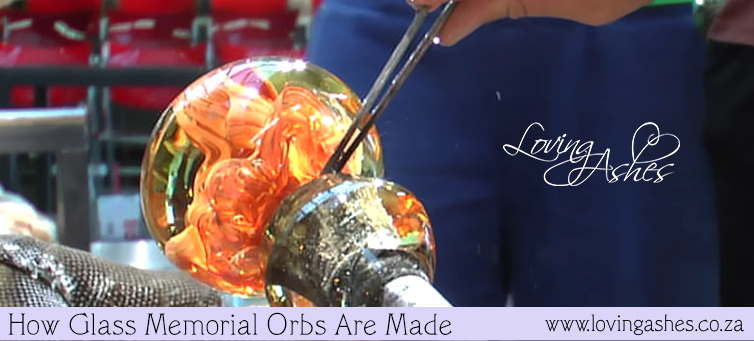
How much do we really know about blown glass? While many enjoy gazing upon stunning hand-blown glass pieces once they’re complete, very few know exactly what the process entails. It can be defined as the practice of shaping molten glass by blowing air into the glass through a tube. Glass blowing is as much an art form as any other, and most who venture into the unorthodox trade end up loving it. This article takes a look at exactly how blown glass pieces are made, from start to finish.
Step 1: Crushed Glass
It all starts with a furnace. Crushed clear glass is shovelled into a piping hot furnace that melts the shards down to a sticky-looking liquid. A stainless steel hollow pipe is dipped and rotated to collect molten glass on the end. A hole on the side of the furnace, known as the ‘glory hole’, is used to periodically reheat the glass when required.
Step 2: Rolling Ash
Once the molten glass is attached to the blow pipe, it is rolled in cremation ash and reheated. It is then turned on a flat tempered steel table known as the ‘marver’, which cools and shapes the glass. Once the ash has been properly assimilated within the piping hot glass, it is reheated in the glory hole and ready for the next step in the process.
Step 3: Adding Colours
Once the ash has been added to the glass, it is dabbed onto small strips of coloured glass (chosen by the client) and then reheated. The heat of the glory hole melts the strips of coloured glass, which integrate with the ash-containing glass in swirling patterns due to the constant rotating and rolling of the glass.
Step 4: A Clear Layer
To achieve the effect of the colour swirls and ash being within the memorial orb, a final thick layer of clear glass is rolled onto the coloured glass in the furnace by dipping and rotating the blow pipe. At this point, the glass blower is able to blow air through the hollow pipe to ‘balloon’ the glass into shape. Memorial orbs are solid glass, so do not require blowing.
Step 5: Shaping the Orb
A large wooden spoon, known as the ‘block’, is used to shape the glass into a near-perfect sphere. The block is soaked in water, so there is no chance of the wood catching fire. Different blocks of varying shapes and sizes are used by glass blowers to achieve certain shapes and sizes of glass memorial pieces.
Step 6: Finishing Off
To finish off the glass memorial orb, a large pair of scissors known as the ‘jacks’ is used to constrict the now cooling glass close to the end of the pipe. Eventually, after a bit of effort is used while the pipe is turned, the orb breaks free from the blow pipe. Once completely cool to the touch, the dislocation area is sanded down to a flat surface and this is how the orb is able to stand on its own.